Many children with low iron don’t look “sick.” They may still play, smile, and go to school, just with a body that is working much harder than it should. Iron helps carry oxygen around the body. When iron is low, children can feel tired even after resting, but the signs are not always obvious. This guide is simply to raise awareness, not to diagnose.
- School and Concentration Changes
Low iron can affect how well a child focuses. You might notice:
- daydreaming more than usual
- taking longer to finish homework
- struggling to remember things
- teachers saying the child is “not trying”
- Mood and Behaviour
Tired bodies can show up as emotional reactions, but it’s not your child being difficult. Possible signs:
- irritability or a short fuse
- crying more easily
- becoming very quiet or withdrawn
- less interest in playing
- Appetite and Growth
Iron deficiency can affect eating and weight. You may notice:
- slow weight gain
- poor appetite, especially after illnesses
- drinking a lot of cow’s milk (over 500 ml a day), which can block iron from food
For babies and younger children, after 6 months, iron from solid foods becomes important. Some infant formulas are iron-fortified and can also contribute to iron intake when used as recommended for a baby’s age. A healthcare worker can guide you on what’s suitable for your child.
- Physical Signs to Look For
Many websites say to “look for pale skin,” but this can be hard to notice in children with darker skin tones. Instead of checking the face, it’s more reliable to look at the:
- inner eyelids
- gums and tongue
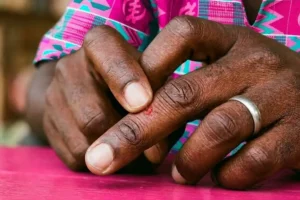
- palms and soles
- nail beds
If these areas look lighter than normal, speak to a healthcare worker.
Anemia affects millions of children every year and some of the signs can be easy to miss. Paying attention to small changes in a child’s energy, appetite or behaviour, and asking a healthcare worker for advice when something doesn’t feel right, can help catch problems early.
References
https://www.mayoclinic.org/healthy-lifestyle/childrens-health/in-depth/iron-deficiency/art-20045634#
https://medlineplus.gov/ency/article/007618.htm#
https://pmc.ncbi.nlm.nih.gov/articles/PMC2486784/#